

How to Source MRO Materials in China? The RFQ Is the Product
Last week an RFQ arrived from a buyer in Mombasa. Eight lines, clean formatting, quantities, destination port, Incoterm. Everything a procurement department is taught to put in a request. It could not be priced.

Not because the items were exotic. Because not one of the eight lines carried the information that decides the price of an MRO item.
"Printing solvent, 84 pcs." A piece could be a one-litre bottle or a 200-litre drum. That is a factor of 200 in volume, and the price per litre moves with it. "Printing ink, 24 pcs." Twenty-four kilos or twenty-four one-kilo tins? "Bread slicer blades, 100 pcs" — blades are cut to a drawing, and there is no drawing. "Plastic conveyor, 82 mm, 200 metres" — 82 mm is a family name, not a specification. It tells a supplier which catalogue to open and nothing else.
This is not a criticism of the buyer. It is the normal shape of MRO. Production parts arrive with a drawing, a part number and a revision. MRO items are bought by description, by people who know exactly what they mean and are writing to someone who does not. The gap between those two positions is where quotation delays, wrong shipments and credit notes are born.
An RFQ is not correspondence. It is engineering work, and it is the cheapest engineering work in procurement.
Four kinds of MRO item, four kinds of missing information
Almost every MRO line falls into one of four buckets, and each bucket fails in its own way.
| Type | What the supplier must know | What happens without it |
|---|---|---|
| Chemicals — solvent, ink, adhesives | Pack size, chemistry, application, substrate | Priced against the wrong product; incompatible with your process |
| Made to dimension — blades, guides, wear parts | Length × width × thickness, tooth pitch, hole pattern, machine model | Non-standard item, no quote without a drawing or sample |
| Brand-critical — bearings, batteries, sensors | Exact part number, and whether an equivalent is acceptable | Two- to threefold price spread quoted against the wrong part |
| System-matched — chain, sprockets, rail | Pitch, width, material, and the parts it runs with | A correct chain that cannot run on your line |
Sort your own RFQ into these four columns before you send it. The missing fields announce themselves.
The unit of measure is the first price
Chemicals are sold by volume or weight, and buyers quote by "piece." A drum of screen-wash solvent and a bottle of the same solvent are the same product at wildly different unit prices, and freight changes the ranking again: liquids are heavy, drums are awkward, and a 200-litre drum to Mombasa costs more to move than the solvent costs to make.
State three things for every chemical line: the pack size, the unit the price should be based on, and the chemistry. "Solvent" covers mesh-cleaning wash, thinner and retarder. They are not interchangeable, and the previous TDS is worth more than a paragraph of description.
For ink, add the substrate. Ink for PP, PET, metal, glass and paper sits in different price bands, and general-purpose ink on a difficult substrate is a failure you discover after the run, not before.
The specification that decides whether the part fits
"Plastic conveyor, 82 mm" is the clearest example of a name doing the work of a specification. What the supplier needs is the chain family and its numbers: 82.5 mm working width, 38.1 mm pitch, slat-top, the Rexnord 820-K325 or Intralox 820 equivalent. Then material — POM for general duty, PP where temperature runs higher — and colour, because brown and white are different SKUs.
Then the question buyers forget: what else does this chain need to run? Sprockets, connecting pins, wear strips. Two hundred metres of chain without matching sprockets is a line that stops for a part worth less than the freight.
The same logic applies to the 150 metres of conveyor guides. Guides are a profile, not a material order: K-type, T-type, U-type, straight or curved, UHMW-PE or nylon. If they run with the chain in the line above, the profile has to match the chain, which means the supplier needs both lines together to answer either.
Brand, part number, and the equivalent question
Two lines in that RFQ were brand-critical, and both were one field short.
"TBI Motion bearing, 6 pcs" needs the series and the bore: LM-UU, SBR…UU, KH, and a shaft diameter. It also needs a commercial decision the buyer alone can make — original TBI Motion (Taiwan, China), or a high-quality equivalent. Original and generic sit in different price bands and different lead times. A supplier who quietly substitutes has made a decision that was never theirs to make; a buyer who never says either way has left it open.
"PLC batteries, 10 pcs" is the same pattern, with a twist. The battery is chosen by the PLC, not by the buyer: Mitsubishi A6BAT, Omron CP1W-BAT01, Siemens 6ES7971, Allen-Bradley 1747-BA. Then the mechanical detail that decides whether the battery is usable: bare cell, or with the lead and connector moulded on. One is a commodity; the other is a specific assembly, and the price reflects it.
Lithium batteries travel with paperwork
The AA lithium line looked like the simplest item on the list. It is the one most likely to be stopped. 3.6 V AA is almost certainly Li-SOCl₂ — ER14505 or LS14500. Fine. But lithium cells are regulated for transport: air freight requires a UN38.3 test summary and a safety data sheet, and the carrier will ask who is providing them. Sea freight is slower and easier, and cheaper per cell, which matters little on ten pieces and a great deal on ten thousand.
Ask this at the RFQ stage, not at the booking stage. A supplier who has shipped lithium before will answer in one line. One who has not will discover the problem after your order is packed.
"CFR Mombasa" — say what you actually want
CFR is a precise term and it is often used to mean something looser. Under CFR, the seller pays the ocean freight to Mombasa and clears export; risk passes when the goods are on board in Shanghai; the buyer insures the cargo and handles import clearance and duty. If what you want is a price that lands at your gate with nothing left to arrange, that is DDP, and it costs more — visibly, in the quote, which is the point.
Kenya also applies pre-export verification of conformity to a range of regulated products. Whoever is shipping needs to know whether your items fall inside it and who is paying for the inspection. Better in the quote than in a port storage bill.
What a good supplier does with an incomplete RFQ
There are two possible responses to a request like the one from Mombasa.
The first is to guess, price something plausible, and win on speed. It reads well for a week. Then comes the wrong pack size, the blade that does not fit the slicer, the bearing with the wrong bore, and a conversation about who pays for the return.
The second is to send the RFQ back with questions, item by item, and a date by which a proper quotation will follow. That reply to Mombasa ran to roughly twenty questions across eight lines, and it came with one commitment: a formal quotation within two to three working days of the answers arriving. Twenty questions looks like friction. It is the cheapest hour in the whole transaction — one day of exchange against a container of the wrong goods.
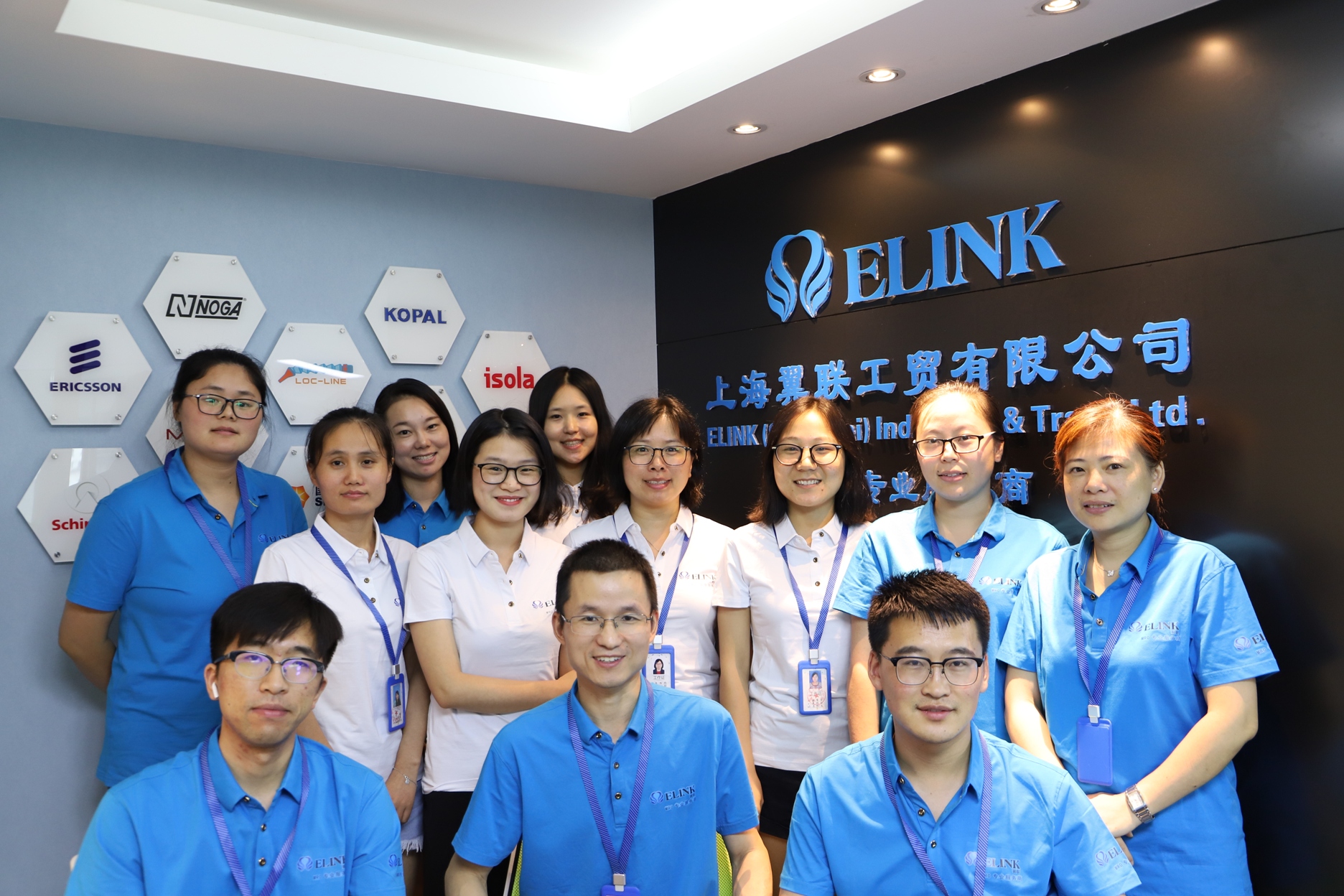
This is where a specialist earns its place. Shanghai-based ELINK has spent seventeen years on exactly this layer: authorised lines from LOC-LINE, NOGA, KOPAL, Filtermist, KURT, QUICK, MicroLoc and others, ISO 9001, an import and export licence, and a warehouse dispatching over a thousand order lines a day. The reason we can ask which chain family you run, or whether your PLC battery needs a connector, is that we pick and pack these categories daily and know which missing field moves the price. A general trading company has to guess. A distributor does not.
The checklist
Before an MRO RFQ leaves your desk, every line should carry:
- Description in catalogue language, not internal shorthand.
- Dimensions or a drawing — photo, sketch, or the old part number off the label.
- Part number and brand, plus whether an equivalent is acceptable.
- Material or chemistry, including substrate for anything printed or coated.
- Pack size and unit of measure the price should be based on.
- Quantity, plus annual volume if this will repeat.
- Destination port and Incoterm — and be honest about whether you mean DDP.
- Required-on-site date, not the order date.
- Documentation you need: COO, MSDS, UN38.3, test reports, PVoC.
- What the part runs with — the machine, the chain, the PLC, the process.
Ten fields, five minutes per line. It is the difference between a quotation and a negotiation about what was actually ordered.
The take
The unit price is the easy part of MRO sourcing. Everything in front of it — the pack size, the bore, the pitch, the substrate, the connector — is what the price is made of.
Write the RFQ as if the supplier has never stood on your line. The ones who send questions back are not slowing you down. They are the ones planning to ship you the right part.
Need a supplier who does not have to guess? ELINK — 17 years of MRO distribution in Shanghai, multi-brand authorised lines. Send us your next RFQ: art@elinkmro.com.
Email: art@elinkmro.com
Tel: +86 21 5017 0881
Mobile/WeChat: +86 138 1777 5656
Add: Room 602, Bldg 11, 3855 Shangnan Rd, Pudong, Shanghai