

Filtermist FX4002 & FX5002 Installation Story:Clean Air Starts at the Source
In precision machining workshops, oil mist is never a small matter. As CNC machine tools run at high speed, coolant is atomized into micron-sized oil mist particles that linger in the workshop air — coating equipment and floors, and entering workers' lungs with every breath. Recently, the service team of ELINK (Shanghai) Industrial & Trade Ltd., authorized distributor of Filtermist in China, installed and commissioned two Filtermist oil mist collectors — the FX4002 and FX5002 — at a customer's facility. This article walks through the full journey, from unboxing to operation.
Before arrival: one machine tool, one tailored solution
The team first surveyed the workshop: vertical machining centers in neat rows, spotless green epoxy flooring — a well-managed precision manufacturer. The customer admitted that their previous centralized ducting system suffered long runs, high airflow resistance and tedious maintenance. That is exactly why we recommended the Filtermist FX4002 and FX5002: single-unit, machine-mounted design with an external bypass — one collector per machine, capturing oil mist at the source, with no need for long workshop duct networks.
Unboxing: British rigour in the details
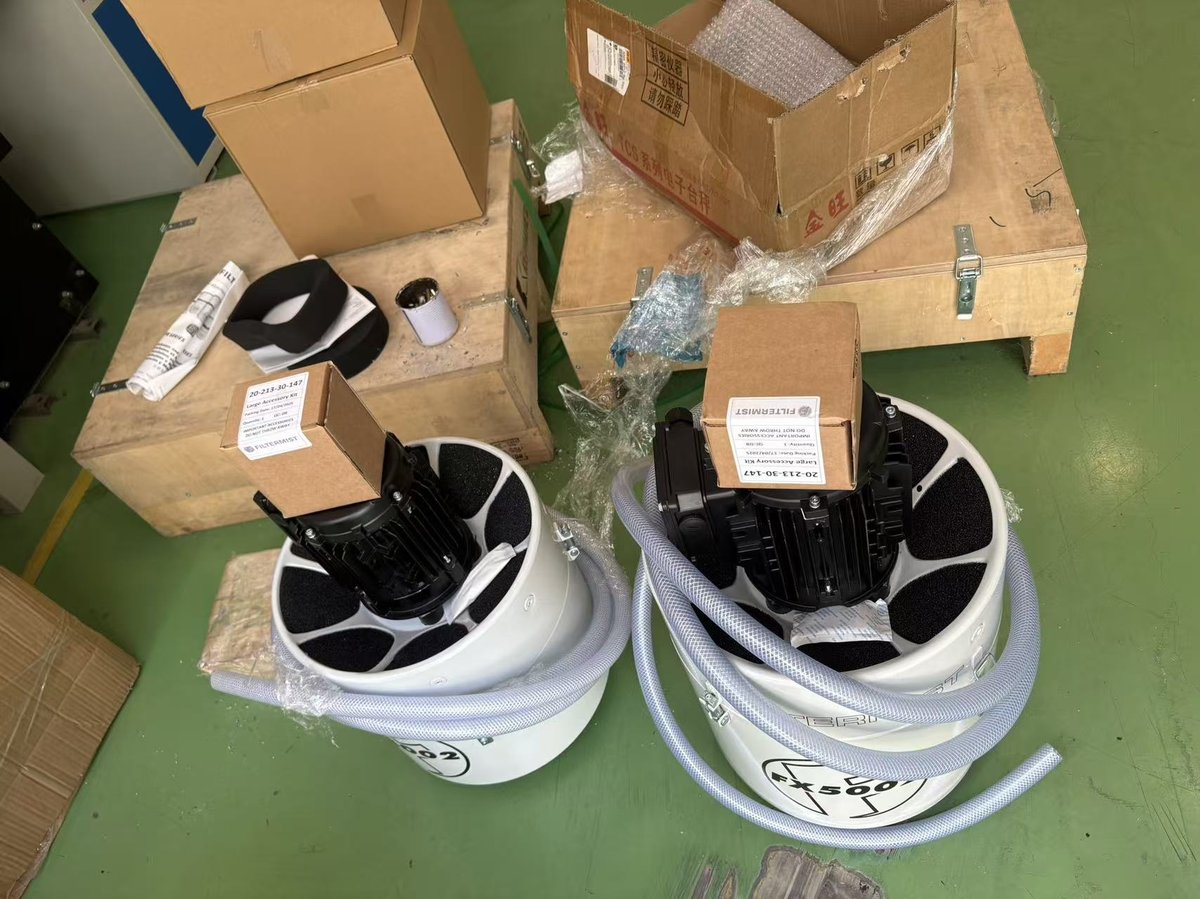
Out of the crate, the FX4002 and FX5002 are compact and cleanly finished, with the black primary filter layer pre-installed, plus a transparent suction hose, mounting parts and manual. Each nameplate carries the full model, serial number and UKCA/CE marks. As the authorized Filtermist distributor in China, ELINK supplies every unit through the official factory channel — serial numbers can be verified with the manufacturer, so customers receive genuine UK-built equipment, guaranteed. After checking the packing list item by item, installation began.
Core installation: from filter stages to motor wiring
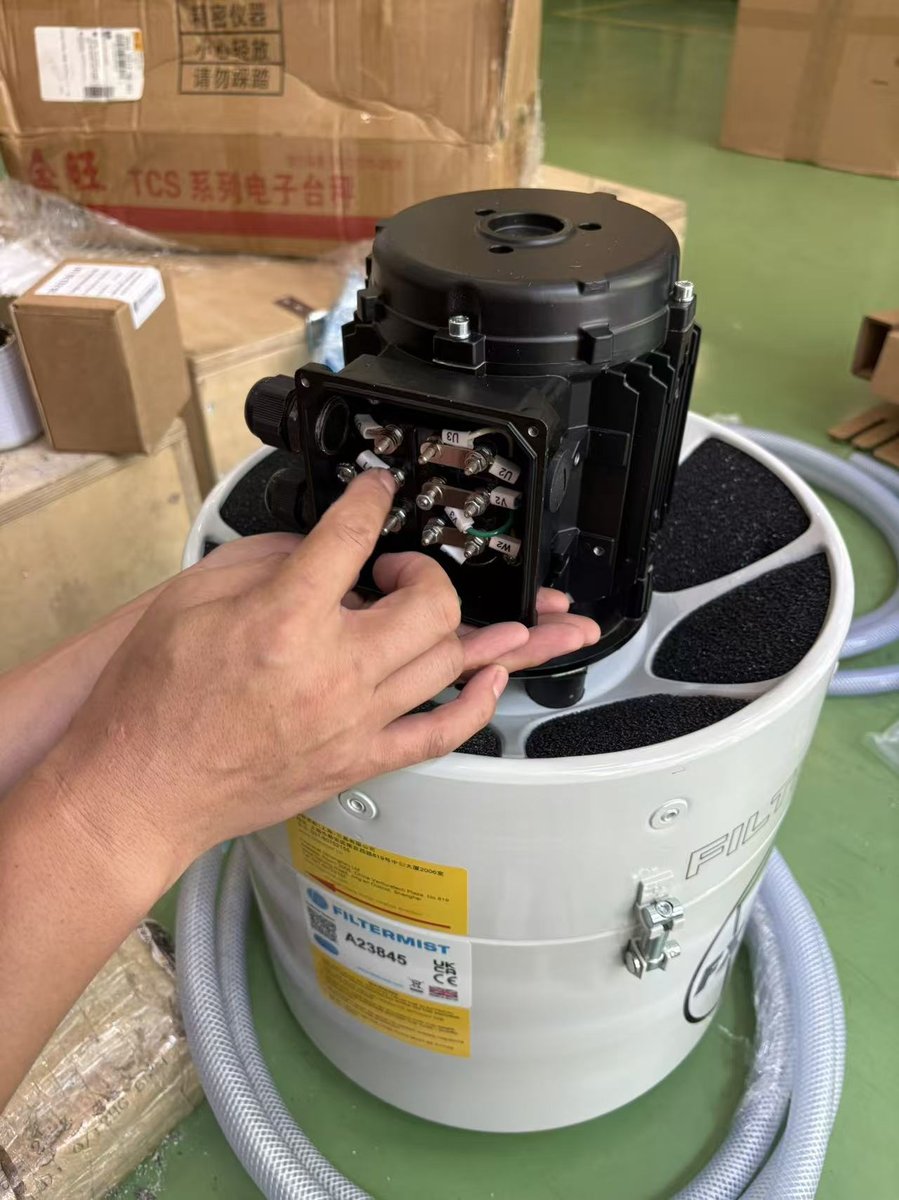
Installation starts with the unit itself. Wearing protective gloves, the technician fits the top filter assemblies one by one — Filtermist's multi-stage filtration first captures coarse particles in the primary layer, then intercepts micron-sized mist in the core filter cartridge, discharging clean air from the top; for stricter emission requirements, an SPX after-filter (HEPA grade) is available. For wiring, the technician opened the motor junction box, verified the voltage against the nameplate, tightened terminals U1, V1, W1 and completed earthing. Filtermist motors support multiple voltage standards; on site it was connected at 380 V three-phase, with clearly marked terminals that any electrician can handle.
Bracket and ducting: mounting the unit on the machine
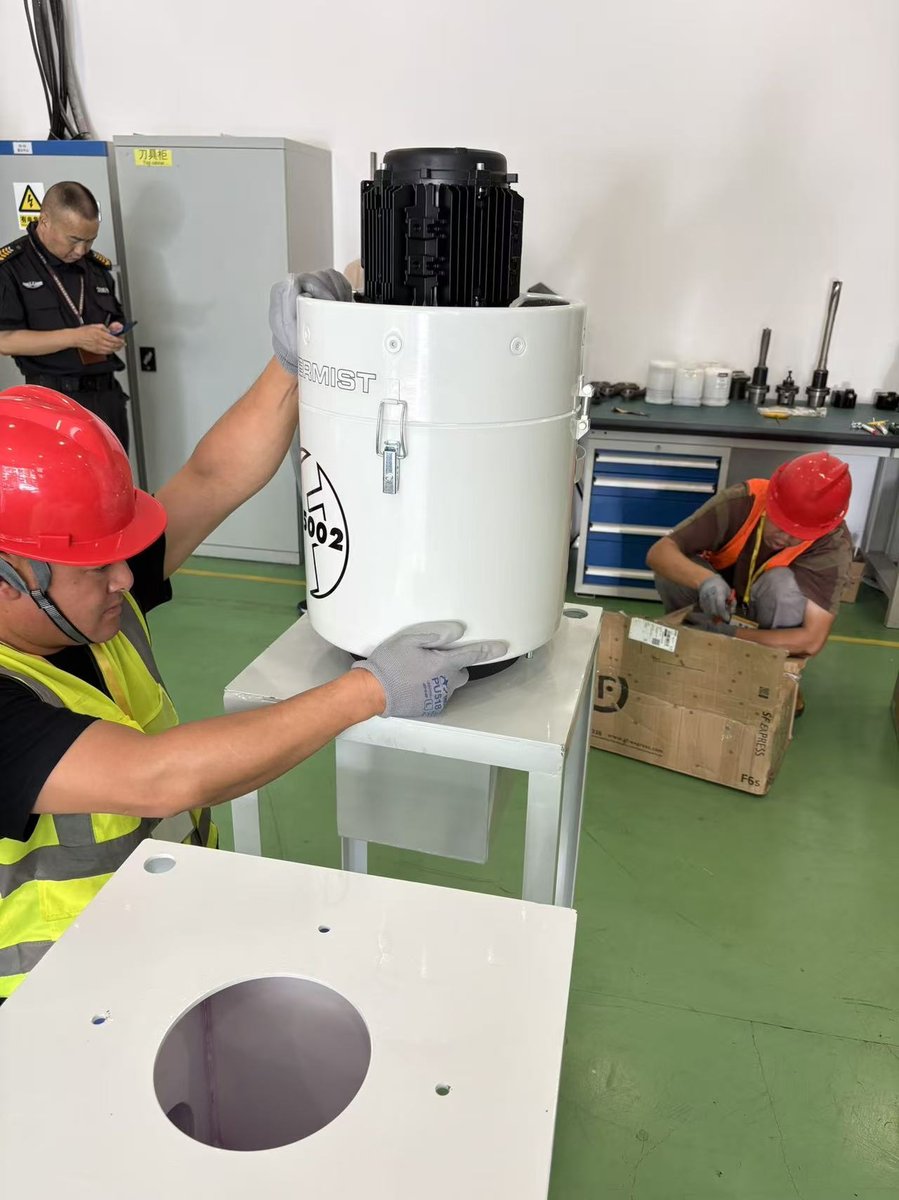
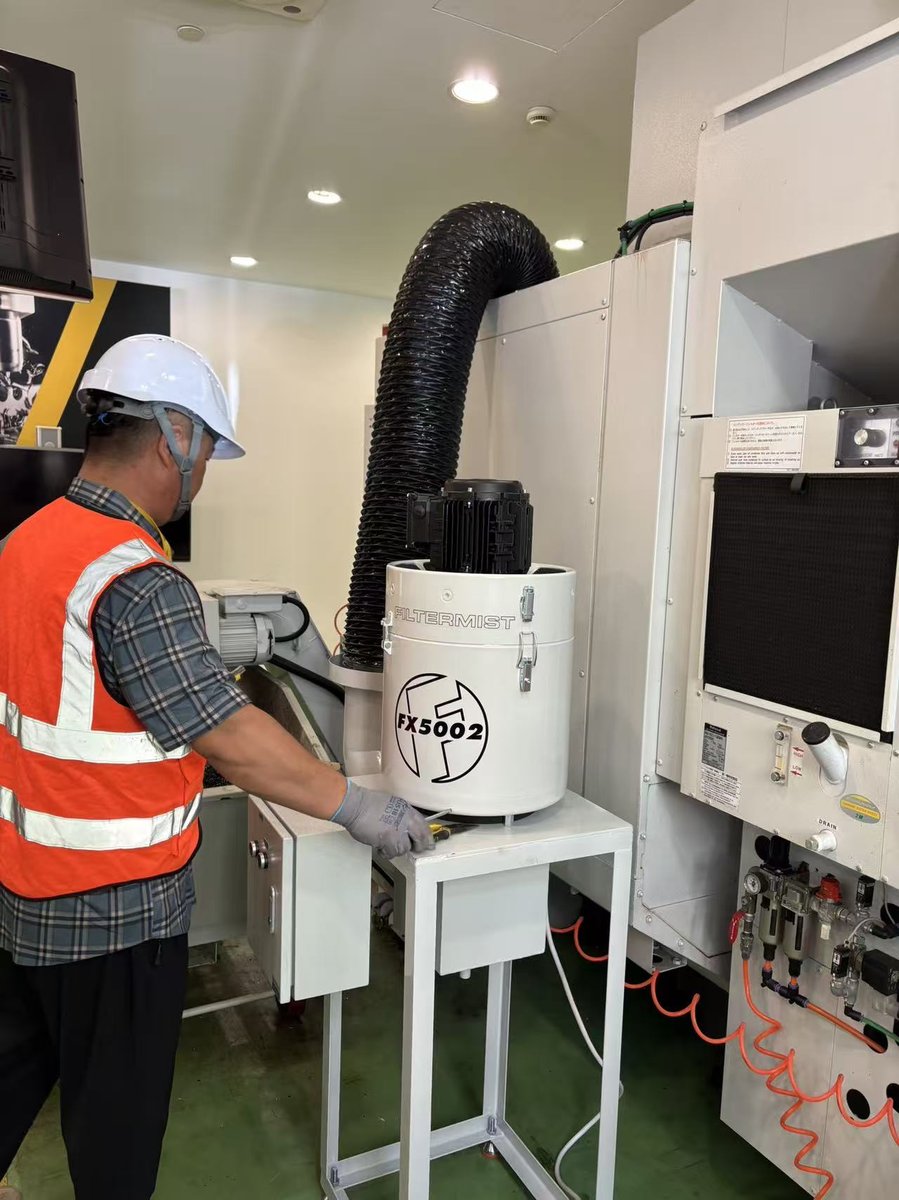
The FX5002 sits on a high-strength bracket bolted firmly to the machine top — stable in operation and easy to remove for maintenance. The reducing elbow on the bracket brackets seamlessly with the machine's original exhaust port, minimizing resistance and noise. The black oil-resistant flexible duct bends with a small radius, adapting to tight machine-top spaces; both ends are secured with hose clamps so nothing falls off or leaks under negative pressure.
Electrical control: independent start-stop, intelligent interlock
Two dedicated control cabinets were supplied: breakers, contactors and thermal relays neatly arranged, with red/green start-stop buttons within reach of the operator. We also interlocked the collectors with the machine spindle: machine on — collector starts automatically; machine off — the collector keeps running with a time delay to purge residual mist from the duct. It saves power, spares operators the trouble, and prevents mist escape when someone forgets to switch it on.
Commissioning: cleanliness you can see
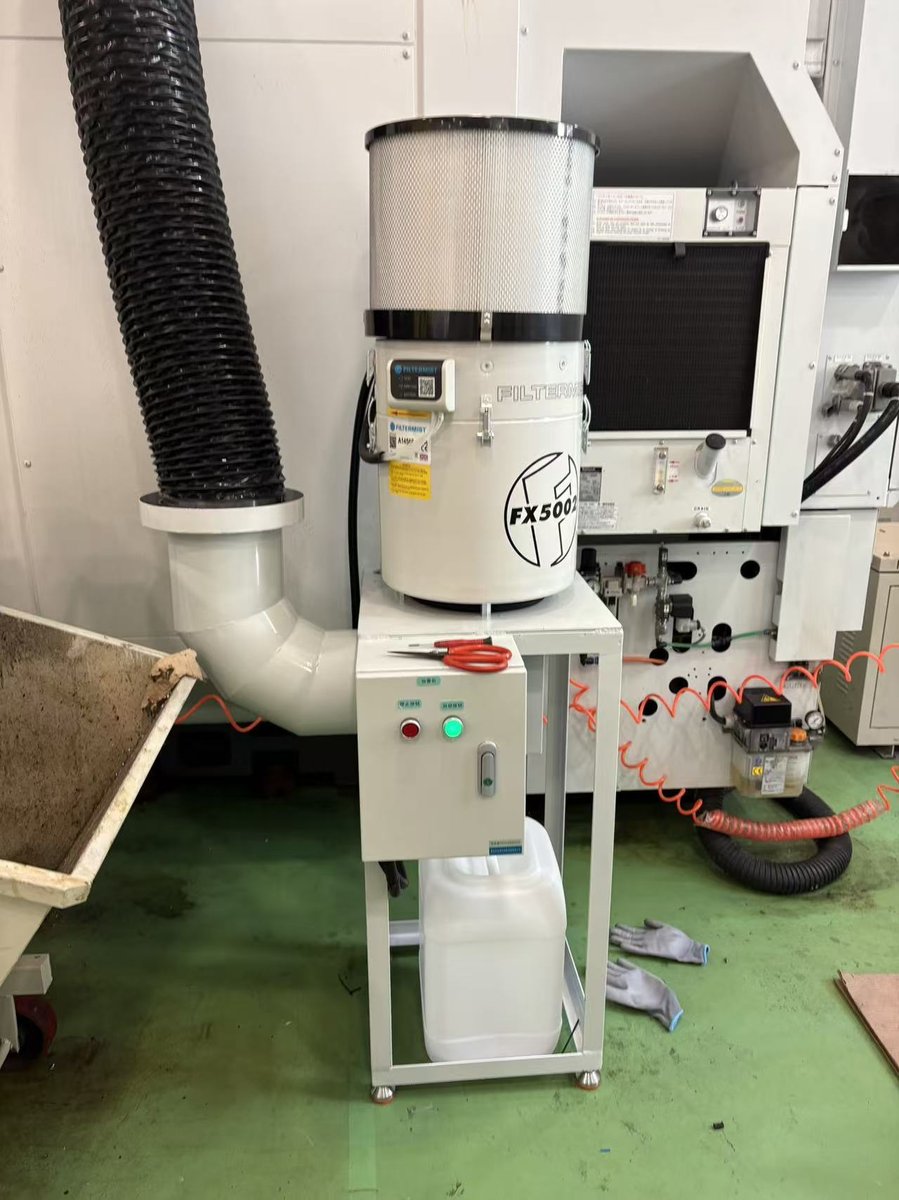
During commissioning, filter differential pressure, running current and motor temperature rise all stayed in the normal range, and at full load the unit is quiet enough for a normal conversation — the operators' first reaction: "Is it actually running? Why so quiet?" The most visible proof is inside the machine: the viewing window no longer fogs up, and the familiar coolant smell in the workshop has clearly faded. For precision machining, timely mist extraction also means less coolant residue and lower risk of workpiece re-contamination — the value of clean air finally shows up in product quality.
Closing thoughts: one installation, long-term protection
- Source control: mist is captured inside the machine — no spread, no build-up;
- Plug and run: single-unit mounting, no workshop ducting rebuild — installed and operating the same day;
- Low maintenance: quick filter changes, near-zero routine cost;
- Low noise: normal communication in the workshop is unaffected;
- Expandable: optional SPX after-filter and condition monitoring modules for the strictest emission and compliance requirements.
As the authorized distributor of Filtermist in China, ELINK (Shanghai) Industrial & Trade Ltd. delivers more than genuine equipment: site survey, system design, installation and commissioning, filter replacement and periodic inspections — the full life-cycle service, so that every worker breathes clean air.
If oil mist is troubling your workshop, contact ELINK for a free on-site assessment and a tailored solution: Tel +86 21 5017 0881, Mobile/WeChat +86 138 1777 5656, art@elinkmro.com.
Filtermist is a registered trademark of Filtermist Ltd., UK; photos are taken on site at the customer's facility. ELINK (Shanghai) Industrial & Trade Ltd. is an authorized Filtermist distributor.